Mary Ann Bevan’s life began in late-19th-century East London, a world where compassion toward physical differences was scarce and medical understanding lagged far behind what we know today. Born on December 20, 1874, in Plaistow, she grew up in a working-class environment and carved out a future for herself through determination and skill. As a young woman she trained to become a nurse, earning a reputation for competence, kindness, and a calm presence that reassured patients. Those who knew her described her as warm, steady, and striking in appearance — a woman with a full life unfolding ahead of her.
In 1902, she married Thomas Bevan, a farmer from Kent. Their marriage brought stability, affection, and purpose. Together they raised four children, building a lively and loving household despite the economic challenges of the time. For more than a decade, Mary lived the life she imagined: a dedicated nurse, a devoted wife, and a mother committed to giving her children the best start she could manage. But her story took a sharp turn when tragedy struck. In 1916, Thomas died unexpectedly, leaving Mary widowed at forty-one. Suddenly she faced the responsibility of raising four children alone, at a time when widowed mothers had almost no social support, no government assistance, and few ways to sustain a household on a single income.
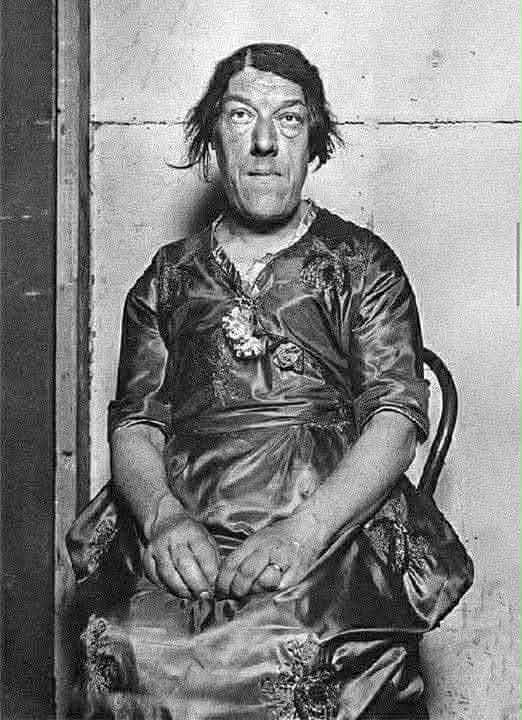
Around this same period, Mary began noticing unusual changes in her body — subtle at first, then unmistakable. Her facial structure slowly shifted, her hands and feet grew larger, and her bones seemed to thicken. She had no name for the condition and no doctor who understood the cause. Today, we know she suffered from acromegaly, a hormonal disorder caused by a benign tumor on the pituitary gland that leads to excessive growth hormone in adulthood. At the time, however, the diagnosis didn’t exist. Without treatment options or guidance, Mary watched her appearance change beyond her control. Those changes cost her the nursing work she depended on. Her employers didn’t understand her condition and responded with the kind of cold discrimination common in that era.
Bills continued piling up. Four children needed food, clothing, schooling, stability — all things Mary was determined to provide. She was proud, but she wasn’t naïve. She understood that resilience alone couldn’t pay rent. Eventually, faced with financial desperation, she made a decision that would define her public legacy, though not the truth of who she was.
Mary answered an advertisement seeking individuals with unusual physical features for work in a traveling show. These shows were part of a harsh entertainment tradition that often exploited people living with medical conditions. Mary knew exactly how the world would see her if she took the job, and she struggled with the choice. But her priority was simple: protect her children and give them a future. Whatever judgment strangers might cast meant nothing compared to that mission.
Contrary to the cruel caricatures that newspapers and posters later created, the people who actually worked with Mary described her very differently. Agents and show managers noted her dignity, strength, and good health. She wasn’t a helpless figure swept into a spectacle — she was a mother making the only viable choice available to her. Her income from the shows allowed her to send money home for her children’s education, housing, and care. The work was difficult, but it ensured her family’s survival. That alone speaks volumes about her courage.
Her image spread quickly. Posters, postcards, and advertisements circulated across Britain and the United States. She eventually performed at Dreamland Circus in Coney Island, one of the most prominent entertainment venues of the time. The crowds were massive, and the attention was relentless. Some onlookers mocked what they didn’t understand. Others looked at her with curiosity or pity. But Mary remained focused. She endured the public gaze because she had a goal that mattered more than pride: securing a stable life for her children.
During this period, her story attracted the attention of Dr. Harvey Cushing, a pioneering neurosurgeon whose research would eventually shape modern understanding of pituitary disorders. Dr. Cushing recognized immediately that Mary’s appearance was caused by acromegaly, not by anything she chose or could control. In his writings, he emphasized her humanity, her persistence, and her unyielding devotion to her family. At a time when the press reduced her to a spectacle, his voice offered a rare perspective rooted in empathy and science. His acknowledgment didn’t change her circumstances, but it challenged the narrative that defined her in the public eye.
Mary worked for many years, sending money back to England until she finally earned enough to secure her children’s futures. Once she was confident they were safe, educated, and stable, she allowed herself to slow down. The years of strain had taken a toll. Her health weakened, and her condition continued to progress untreated. Still, she lived her final years knowing her sacrifices had succeeded.
Mary Ann Bevan died at the age of 59. Her last wish was simple: to be buried in her homeland. Her family honored that request, bringing her back to England for her final rest. Long after her death, her story continued to circulate — often stripped of its context, often reduced to a single image instead of the full truth.
But today, her life is increasingly understood through a different lens. She wasn’t a spectacle. She wasn’t a punchline. She was a woman who faced a medical condition beyond her control in a time when society offered no compassion for it. She made choices no mother should ever be forced to make, and she made them with clarity, courage, and unwavering love for her children. Her legacy isn’t the distorted label she endured, but the strength she carried. Her journey is a reminder of how easily society can misjudge people, and how much resilience can be found in those who refuse to be broken by circumstance.
Mary Ann Bevan’s story endures because it speaks to something universal: the power of a parent’s devotion, the dignity of someone who keeps going despite the odds, and the quiet heroism of choosing your children’s future over your own comfort. Today she is remembered not for the cruel ways she was portrayed, but for the depth of her resilience and the unmistakable love that shaped every decision she made.