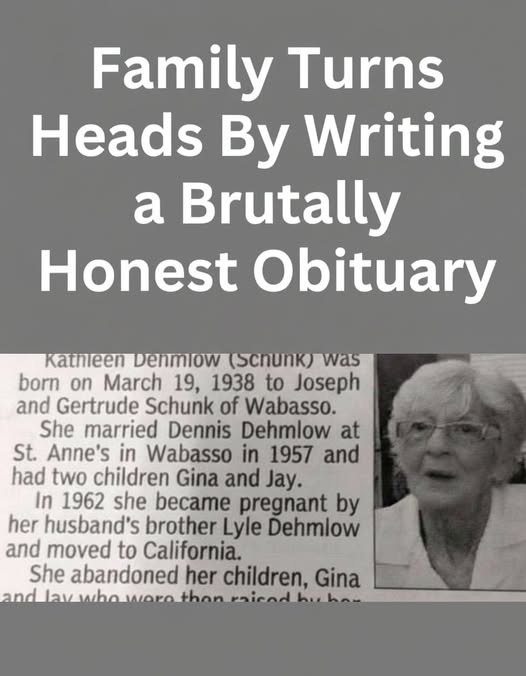
Obituaries usually follow a familiar pattern: warm nostalgia, neatly stitched memories, and a gentle gloss over flaws. But when Kathleen Dehmlow’s obituary hit a Minnesota newspaper, it shattered that expectation. Instead of a polished tribute, it delivered raw, unfiltered truth—pulling private family history into the public eye and sparking national attention overnight. Readers couldn’t look away. This wasn’t your usual “loved by all” farewell—it was honesty, blunt and unapologetic.
The obituary didn’t sugarcoat family tensions. It revealed long-standing conflicts and disappointments with brutal clarity. Comments exploded online: Was it cruel, cathartic, or just honest? Some criticized it as inappropriate for public memorials. Others celebrated it as a rare moment of truth in a space that typically erases the messy parts of life. Despite the mixed reactions, Kathleen—unknown to most—became a symbol of what happens when obituaries break free from convention.
Soon, the obituary disappeared from the newspaper’s website. But by then, screenshots had already spread across social media, cementing its place in internet lore. Dwight, a family member, later provided context, explaining that the obituary reflected unresolved pain from decades earlier, not the entirety of Kathleen’s later life. He emphasized that Kathleen had tried to reconnect with her children and carried genuine regret. Her final printed words were less her voice and more the echo of lingering family resentment.
This added nuance didn’t dampen the public’s fascination. It reminded everyone that behind every obituary is a complex story: memories tangled with loyalties, disappointments, and emotions that last long after someone is gone. Grief is messy, and sometimes final tributes become a stage for the living to process unresolved wounds as much as they honor the deceased.
The newspaper itself addressed the viral uproar. Editors clarified that obituaries are published largely as submitted, with minimal edits except in cases of legal or ethical concerns. They don’t rewrite tone or content. But Kathleen’s obituary was unlike anything they had seen before, prompting internal debate on how to handle emotionally charged submissions. The incident highlighted a delicate balance: respecting families’ right to tell their truth while recognizing that obituaries are public documents read by thousands.
The story sparked a broader cultural conversation. Obituaries are often idealized—glorifying accomplishments, love, and redemption. Kathleen’s, however, forced readers to face the complexities of real lives: mistakes, contradictions, and unresolved pain that don’t vanish at death. Should memorials reflect perfection, or can they embrace truth—even when it’s uncomfortable?
Responses flooded in. People shared their own experiences of fractured families and unfinished conversations. Many admitted they’d felt pressured to write flattering tributes that didn’t reflect reality. Others wished they had acknowledged truths that mattered to them before it was too late. What began as a viral curiosity became a meaningful dialogue about honesty, forgiveness, and the way we honor imperfect lives.
Kathleen Dehmlow’s obituary—raw, human, and deeply real—proved that every life contains chapters the public rarely sees, and every family carries stories shaped by memory, perspective, and emotion. In the end, it wasn’t just about the obituary—it was about the living: conflicted, grieving, and trying to make sense of lives that don’t fit neatly into tradition. Memorials, it turns out, reveal as much about the living as they do about the departed.
Want more stories that challenge what we think we know? Keep reading, share your thoughts below, and join the conversation!