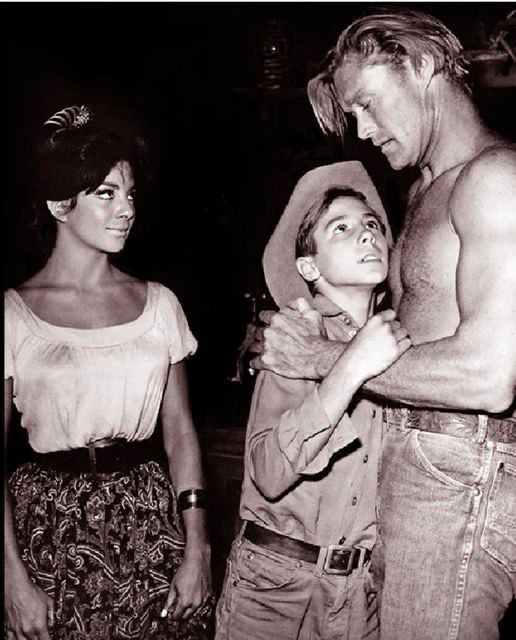
For generations, The Rifleman has held a special place in the hearts of TV fans. Even sixty years after its debut, people still talk about the powerful father-son relationship at its center — the bond between Lucas McCain and his son Mark. In an era when television was still finding its voice, this Western became a fixture in countless American homes, offering stories built on courage, decency, and the values parents hoped their kids would actually learn from watching.
The show wasn’t just entertainment; it was a weekly reminder of what integrity looked like. But behind its polished episodes lay a world of quirks, slip-ups, and lesser-known details that even dedicated viewers may have missed. Like most early Westerns, The Rifleman played fast and loose with historical accuracy. And honestly, that’s part of the charm. The heart of the show mattered far more than whether props or clothing matched the exact decade. Still, some of these bloopers and behind-the-scenes stories are too good not to share — and they reveal just how much personality and improvisation helped make the series legendary.
One of the most amusing discoveries involves Lucas McCain’s wardrobe. Fans remember him as the rugged, straightforward cowboy hero, always ready with his rifle and a wise word for his son. But in the episode “End of a Young Gun,” there’s a quick moment where Chuck Connors, shirtless and repairing a wagon wheel, leans over just enough for viewers to catch the unmistakable “W” stitched onto the back pocket of his jeans. He’s wearing Wranglers — which didn’t exist in the 1880s. Those jeans wouldn’t be manufactured until the 1940s. In other words, Lucas McCain was unintentionally the best-dressed man of the Old West, half a century ahead of style trends.
There are also moments of sweetness threaded through the show’s history, including the quiet appearances of Chuck Connors’ real-life family. In the episode “Tension,” viewers meet the widow and son of Sid Halpern, an old friend of the McCains. The boy, Toby, has only two lines — but what fans didn’t know is that he was played by Jeff Connors, Chuck’s own son. Jeff later went on to become a film editor and passed away in 2014, but his brief on-screen moment with his father remains a small, meaningful gem in the show’s legacy.
Landing Chuck Connors for the role of Lucas McCain wasn’t a straightforward process, either. ABC originally offered a salary so modest that Connors turned them down. At the time, he made more money freelancing, and becoming the face of a weekly series didn’t look like a financial upgrade. But fate has a sense of humor. Producers took their kids to see Old Yeller, where Connors played a strong, compassionate father figure. When the children reacted emotionally to his performance, the producers reconsidered their offer. They came back with more money and, crucially, a five-percent ownership stake in the series — an unusually generous deal for a TV actor in the 1950s. With that, Connors signed on, and The Rifleman got its iconic lead.
The rifle itself deserves its own chapter. The opening sequence of every episode is unforgettable: Connors firing off a rapid series of shots, the rifle spinning, cocking, and loading with incredible speed. Many assumed this was trick photography. It wasn’t. Connors, a former professional athlete, had the reflexes and coordination to make the movements look effortless. The production used two identical Winchester 1892 rifles — one primary, one backup — and they were customized for rapid firing. Even so, Connors’ athleticism did most of the work.
Ironically, the series is set well before the Winchester 1892 existed. The show takes place in the 1870s and 1880s, making the appearance of this rifle a historical impossibility. But here’s the real twist: Lucas McCain’s rifle wasn’t just any Winchester — it was the same rifle used by John Wayne in the 1939 classic Stagecoach. Producer Arnold Levin later confirmed this, giving The Rifleman a direct line to one of the most celebrated Westerns in film history. It’s a connection that fans still talk about, tying the show to Hollywood’s larger Western mythos.
Another fascinating detail sits quietly in the background of many episodes: the Madera Hotel. This building became one of North Fork’s most recognizable landmarks, appearing in crowd scenes, street shots, conversations, and confrontations. What most viewers never realized is that the Madera Hotel wasn’t always consistent. Because it was reused so often — sometimes with slight changes to its signage or structure — it accidentally became a running piece of continuity humor. Sharp-eyed fans have spotted furniture, wallpaper, and even staff members mysteriously shifting from one episode to another, all because the production reused sets to stay within budget. Far from detracting from the show, these repeats now feel like an endearing signature of classic TV production.
And the historical inaccuracies? There were plenty. Guns that didn’t exist yet. Clothing from the wrong decade. Props that magically reappeared after being destroyed in earlier episodes. Even the geography of North Fork seemed to shift from time to time, with certain landmarks showing up in one season and disappearing in the next. But none of that mattered, because the emotional core was so strong. The show wasn’t pretending to be a documentary; it was telling stories about bravery, forgiveness, loyalty, and love — the things that never go out of style.
More than anything, The Rifleman endured because of the chemistry between Chuck Connors and Johnny Crawford. Their father-son dynamic felt real, layered, and grounded in genuine affection. Crawford, who was only 12 when the show began, later said that Connors became a mentor to him, on and off screen. Their connection is what gave the show its soul, elevating it above other Westerns of the era. Each episode carried a subtle moral backbone, with Lucas teaching Mark lessons that parents across America hoped their own children absorbed.
Looking back, the little mistakes — the Wranglers from the future, the anachronistic rifle, the recycled sets — don’t tarnish the show’s legacy. They make it more human. They reveal the constraints and creativity of making television in an era without digital editing, continuity teams, or massive budgets. And they highlight how much passion the cast and crew poured into every episode.
Today, The Rifleman remains a timeless classic, not because it was perfect, but because it was heartfelt. It reminded viewers that strength doesn’t require cruelty, that raising a child takes patience and courage, and that doing the right thing often means standing alone. In a world that changes constantly, those values still resonate — and maybe that’s why fans keep returning to North Fork, eager to relive the stories, the lessons, and yes, even the bloopers that made the show unforgettable.