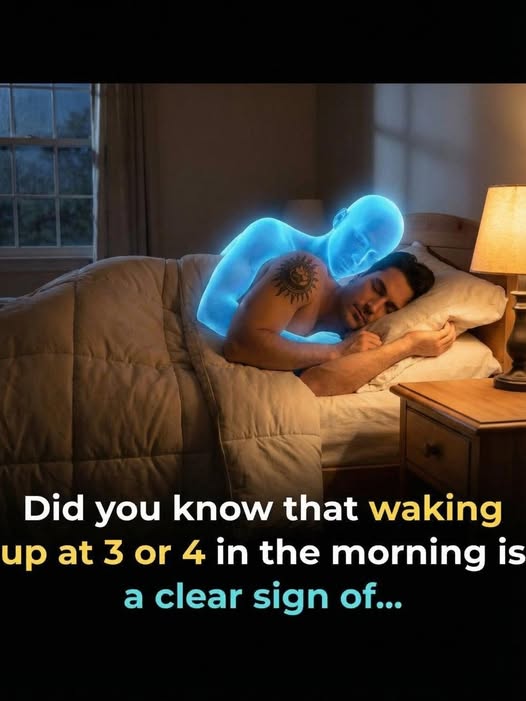
Most people think of sleep as a single smooth stretch of rest, but anyone who’s ever found themselves suddenly wide awake between 3:00 a.m. and 5:00 a.m. knows it isn’t always that simple. You go to bed at a normal hour, maybe even exhausted, yet your eyes snap open in the dead quiet of early morning. The room feels different. Your thoughts feel louder. And when sleep refuses to return, the following day carries the weight of whatever jolted you awake.
It’s a more common experience than most people realize, and it often leaves people wondering if something deeper is going on. Interestingly, both ancient traditions and modern research point to this early-morning window as a uniquely sensitive period for the human body and mind.
Long before scientists studied circadian rhythms, cultures around the world gave a name to those dark, lonely hours. Swedish folklore calls it “the hour of the wolf,” a phrase describing the moment just before dawn when people feel most vulnerable—when anxieties flare, the night feels heaviest, and the brain seems more exposed. Literature, religion, and folklore repeat the same theme: this window of time amplifies emotions and inner conflict. People noticed centuries ago that waking during this period felt different, even if they couldn’t explain why.
Today, science offers a grounded explanation. Between roughly 3:00 a.m. and 5:00 a.m., the human body dips into its lowest physiological point. Core temperature is at its minimum. Metabolism is at its slowest. Blood pressure drops. Breathing stabilizes into a deeper, quieter rhythm. Stress hormones are at their lowest level of the entire 24-hour cycle. In other words, your body is doing its heaviest repair work, operating at its most fragile state.
Because everything is dialed down, even small disruptions can snap you awake. A drop in blood sugar, a shift in room temperature, dehydration, or even a distant noise can shake the system because the body doesn’t have the energy reserves at that hour to buffer the disturbance.
But there’s another layer. When someone is carrying stress—emotional, physical, or mental—the early-morning hours magnify it. During this time, the logical, alert part of the brain is still “asleep,” while the emotional centers are more active. That’s why you may wake with racing thoughts, sudden worries, or a sense that something is wrong even if your life is perfectly stable. The brain interprets stress differently when the body is at its lowest energy point. Problems feel sharper. Emotions feel heavier. And because the world is silent and dark, there’s nothing to distract you from your own mind.
For people going through grief, anxiety, burnout, or unresolved conflicts, this window often becomes a recurring wake-up call. The body treats stress like a potential threat—so it rouses you from the deepest sleep stage, even if the danger is entirely internal.
Of course, not everyone wakes up due to emotional strain. Sometimes, the explanation is far more practical. Drinking too little water during the day, consuming caffeine too late, scrolling on a bright phone screen before bed, or sleeping in a stuffy environment can all disrupt the sleep cycle precisely during those fragile early hours. Poor sleep hygiene doesn’t always show itself at midnight—it often breaks down the moment your body tries to shift into its most restorative phase.
Some people even wake because of habits they don’t recognize as disruptive—eating too close to bedtime, inconsistent sleep schedules, or exposure to blue light late at night. These behaviors interfere with melatonin, the hormone that regulates sleep, making your internal clock hit turbulence right when it should be gliding smoothly.
Still, for many, waking at 3–5 a.m. isn’t random. It’s a signal. The body often uses this window to communicate that something—physically or emotionally—is out of alignment. Instead of seeing it as a strange or mystical event, it helps to interpret it as feedback.
If the cause is physical, the solution may be simple: more hydration, earlier dinners, less screen time, a cooler room, or more consistent sleep habits.
If the cause is emotional, the awareness can become a starting point for change.
Stress buried under routines you barely notice. Anxiety you keep pushing through the day without addressing. Decisions you’ve postponed. Feelings you’ve ignored because you’re too busy to deal with them. These things tend to resurface when the mind is unguarded—when the world is quiet, and the body can no longer numb itself with productivity or distraction.
That doesn’t mean something is wrong with you. It means your body is trying to be heard.
For people who sleep soundly through the night, the 3–5 a.m. window is just another phase of the sleep cycle doing its job—deep restoration, memory processing, cellular repair. For those who wake during that time, it may be a sign that something in their system—emotional, environmental, or physiological—needs attention.
The reassuring truth is that these awakenings don’t need to become a long-term pattern. Small changes can make a meaningful difference: a consistent sleep routine, calming pre-bed rituals, lower evening lights, limiting stimulants, staying hydrated, and managing stress in ways that actually release it, rather than simply suppressing it.
Understanding this early-morning phenomenon replaces fear with insight. Instead of wondering whether something mysterious or alarming is happening, you gain a clearer picture of how your body works—and how sensitive it becomes during its deepest repair cycle.
The next time you find yourself awake at 3:30 a.m., staring at the ceiling, don’t panic. Don’t assume the worst. Instead, see it as a moment of awareness—a message from your body that something deserves a closer look.
Because once you understand what’s behind these awakenings, you’re no longer at the mercy of them. You can support your body, adjust your habits, improve your sleep environment, address your stress, and, over time, restore the uninterrupted rest you deserve.
Waking between 3 and 5 a.m. isn’t a mystery. It’s information. And with the right changes, it’s absolutely something you can overcome.