In early December 2023, a powerful tornado outbreak carved a brutal path across Tennessee, leaving behind a trail of destruction that stretched for miles. Clarksville suffered some of the worst damage, with entire neighborhoods reduced to splinters in a matter of minutes. Homes that had stood for decades were flattened. Trees were uprooted like weeds. Families emerged from the wreckage stunned by the speed at which their world had changed. Amid this devastation, one family’s story rose to national attention — not because their loss was small, but because their survival bordered on miraculous.
Sydney Moore lived in a mobile home with her boyfriend and their two young children — a 4-month-old baby and a 1-year-old toddler. The morning had begun quietly, even ordinarily. Weather alerts circulated, but severe warnings are common in Tennessee, and few anticipated the tornado’s sudden strength. Within minutes, the storm intensified into something far more violent than anyone expected.
As the winds picked up, the family gathered inside their home, hoping to wait out the storm as they had so many times before. But this tornado did not pass them by. It struck directly. The roof tore away first, then the walls buckled, and the structure began to disintegrate around them. Inside, their infant lay in a bassinet — a detail that would soon become the center of an unbelievable survival story.
A violent gust lifted the bassinet into the air and carried it out of the collapsing home. Sydney’s boyfriend leapt instinctively to grab the child, but the same wind pulled him outside as well. Sydney clutched her toddler to her chest, shielding him as debris fell around them, the world becoming a blur of noise, splinters, and terror.
When the tornado finally passed, there was no home left — only scattered remains of what once had been. Sydney and her toddler managed to escape the rubble, bruised but alive. Her boyfriend survived too, though he had been thrown yards away by the force of the winds. But their baby was nowhere in sight.
For ten unbearable minutes, they searched frantically through debris, calling out, lifting broken boards, climbing over mangled metal. Grief hovered in the air, an unspoken fear tightening around every breath.
Then — a cry.
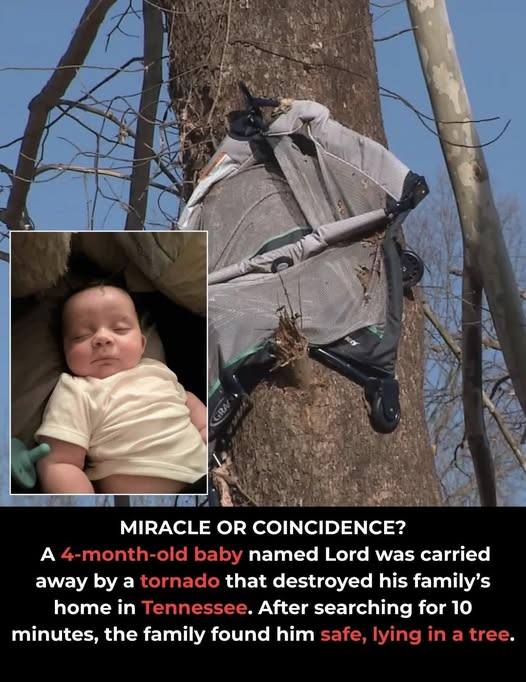
They found the infant lodged safely in the branches of a fallen tree. The bassinet, carried by the storm like a leaf, had landed in a pocket of branches that protected rather than crushed him. Aside from minor bruising, the baby was unharmed.
Their home was gone. Their belongings were gone. But their family — all four of them — were alive.
In the days that followed, community members stepped forward with an outpouring of support. Neighbors who had lost their own homes offered clothing, supplies, meals. Local organizations provided shelter and resources. People came together not only to rebuild structures, but to comfort one another in the shared grief of what had been lost.
The Moore family’s survival became a symbol of hope — a reminder that even in the heart of catastrophe, life can cling to the smallest branches, and love can create space for miracles. Their story did not erase the devastation, but it illuminated something quieter and deeply human: the resilience that emerges when everything else has been stripped away.